.quickedit{display:none;}
Showing posts with label Review. Show all posts

Saturday, 15 February 2014

The (Not So) Merry Wives of Reno (1934)

A witty play on words from Shakespeare’s iconic play, Merry Wives of Reno (1934), focuses on the muddled lives of three quintessential Precode couples – perfect newlyweds, a cheating much younger wife and an older couple that never seem to see eye-to-eye. The champions of the film are three second banana staples of the early 1930’s – Glenda Farrell, Guy Kibbee and Hugh Herbert - who cause trouble for the youthful loved up couple, Donald Woods and Margaret Lindsay. Their performances only outdone by the hilarious comic relief from Eloise, a playful, animated and always present sheep.
 
Frank (Woods) and Madge (Lindsay) are a sugary married couple celebrating their first anniversary. As gifts they buy each other expensive overcoats and plan a romantic diner. Their neighbours, however, are the unhappy couple Tom (Kibbee) and Lois (Ruth Donnelly) whose decade’s long marriage has been filled with arguments, plate throwing and husbandly infidelity. Bunny (Farrell), a wealthy wife, with her husband out of town is bored and looking for excitement invites Frank over on the pretence of buying a boat from him. He soon finds out she wants more than just a sea vessel and tries desperately to leave the apartment before the energetic Bunny causes him more trouble. Thankfully it comes in the form of Tom who is also having a casual fling with the bored housewife arrives, drunk, looking for a fun time. Frank exits, negligently, leaving his new overcoat behind. Minutes later in another comedic twist, Bunny’s husband, Colonel Fitch (Herbert), returns from his business trip, glowing and satisfied, bringing along his new prized possession, Eloise the sheep. Flustered and still intoxicated, Tom exits, also unfortunately leaving his overcoat beside Frank’s in Bunny’s hall closet. 
Margaret Lindsay and Ruth Donnelly
When the husbands finally return overcoat-less – and one of them drunk – to their wives dual arguments ensue. Both creating invented stories as to the location their jackets and not succeeding to persuade their spouses that they are innocent. Impulsively, Madge and Lois conclude that the only solution is to divorce their lying, cheating and mistreating husbands and head to Reno. On the train ride the wives, in a serendipitous moment, finally meet, discover their connection and resolve to leave their marriages behind and find laugher and good times in Reno. Hot on their tails is their jilted husbands who have also joined forces desperate to win their wives back and restore their domestic homes. Following behind is Bunny and Colonel Fitch also on the train destined for Reno with a hidden Eloise under the passenger’s seats.

They all stay at a traditional Reno hotel filled with parties, alcohol and newly divorced women. All paying customers can have any need met by the accommodating concierge, Al, played by the hilarious Frank McHugh, who spends most of his time organising parties and acting as a kind of gigolo for lonely women. The couples constantly switch from separation to reconciliation as they navigate through misunderstandings, drunken nights and other women. In the end all it takes is a taste of their own medicine to bring the wives back to the comfort of their husband’s arms and a happy conclusion for this light-hearted Warner Bros. comedy. 

The use of supporting character actors brings a different edge to the picture. Although it is witty and poignant when it comes to marriage fidelity and infidelity, the film lacks slightly with casting. Both Farrell, Gibbee and name are perfect accompanying actors but seem not strong enough to carry a picture with name and name also a little weak. It appears to be a truly ensemble cast that could have benefited from the inclusion of someone like Joan Blondell or Warren William. The film shines with Eloise who is surprisingly vibrant and dramatic for a sheep. Frank McHugh is also brilliantly included as the naughty but helpful concierge. Merry Wives of Reno is not a great Precode drama or commentary on social issues but is a fun, light way to spend an hour in both in the 30’s and now.     


Thursday, 29 August 2013

Fantastic Francis: 'Mandalay' (1934)


Filled with illicit relationships, alcohol, prostitution, murder without consequence and tons of sexual innuendo, ‘Mandalay’ (1934) is a perfect example of a Precode film at its best. The Warners/ First National production packs a punch at around 65 minutes, a perfect vehicle for the then reigning queen, Kay Francis, alongside habitual irresistible ‘bad-boy’ Ricardo Cortez.

Francis plays Tania Borisoff, a Russian refugee living with her lover, gunrunner, Tony Evans (Cortez) on a yacht in Rangoon, Burma. One night, Tony is offered a lucrative contract trafficking weapons for nightclub owner Nick (Warner Oland). Nick knows of Tony’s relationship with Tania and is using the deal as a front to lure her to work as one of his principle “hostesses” (a euphemism for prostitute). The plan works and Tony abandons destitute Tania at the nightclub and alone, depressed and hopeless, Tania agrees to work as a “hostess” for Nick.

Renaming herself, “Spot White”, Tania creates a new persona for herself; tempting and flirting with men while remaining cool and aloof all with the aim of receiving expensive gifts and money. It is a game that she succeeds at but one that draws the attention of law enforcement. The Police Commissioner (Reginald Owen) eventually breaks and threatens to deport her because of her negative influence on the army officers stationed in the area. Calmly, Spot White blackmails the commissioner using his behaviour towards her one night at a masked party and showing him gifts as evidence. He caves to her pressures, removes the deportation order and even gives her 10,000 rupees for her silence.  With her money, Tania is now free and leaves the nightclub boarding a steamer destined for Mandalay, Burma. She takes on a new identity as Marjorie Lang and aims to put her past behind her. On the boat, Tania meets an endearing but broken doctor, Dr Gregory Burton (Lyle Talbot) who – because of his equally troubled past – has become an alcoholic. They create a repour with Tania persuading Gregory to become sober and slowly fall in love. The couple know the relationship will be short-lived as the doctor is travelling to a camp in the hills plagued with a contagious fever and is unlikely to survive long. 

But Tania’s past couldn’t be forgotten for long as Tony, back from his trip, has entered the boat intending to win Tania back. He books a cabin in a room adjourning hers and begins harassing her to continue their affair. Tania, not forgetting his treatment of her, refuses him. That night Tony receives a letter warning him that the police are after him and to escape. Instead of running, Tony decides to fake his own death. He lures Tania to his apartment for a drink, spikes his drink with poison and ensuring that her glass is clearly marked with her lipstick, opens a window making police believe the drugged man has fallen overboard.  Tony waits, patiently, hiding on a lower deck while Tania is instantly implicated and charged with the death. Thankfully with the assistance of Dr. Gregory, Tania is cleared and the death is ruled a suicide. Later that night, seeing the police have abandoned their case, Tony enters Tania’s cabin still eager for a reconciliation. In a truly Precode moment, Tania poisons Tony and he falls overboard to his death. Finally rid of her past, Tania and Dr Gregory disembark intent on starting a new life in the diseases ridden camps of Mandalay.

For Precode and Miss Francis lovers admittedly this is a very formulaic movie. Francis is spectacular in a strong dramatic role playing between a sultry vamp and a damaged women heavily influenced by her circumstances. Ricardo Cortez and Lyle Talbot are great male counterparts neither portrayed as heroes or villains but realistic depression-era characters. Director Michael Curtiz manages to pack a wide array of interesting shot types, wipes and opticals in the relatively short film. The movie’s most thought provoking element is its ending. It is a pure double-edged conclusion – Tania is finally liberated from her past and has found love with another man; however, she has agreed to follow him to a life that will probably bring both their deaths. This ending is an integral part of many realistic, Precode dramas and makes the film a believable and engrossing tale.                         


Tuesday, 13 August 2013

Norma Shearer Shines in 'The Divorcee' (1930)


I submitted this review as part of Movie Waffler’s ‘1001 Overlooked Movies’ project which aims to promote films that were left out of the ‘1001 Movies You Must See Before You Die’ series. ‘The Divorcee’ (1930) is one of those essential Precode films with a spectacular performance by Miss Norma Shearer. I encourage all bloggers to get involved in The Waffler’s almost impossible task, more information can be found here.

 
“If the world permits the husband to philander – why not the wife?” The controversial question posed by filmmakers in the landmark film, ‘The Divorcee’ (1930) that ushered in a new generation of woman’s rights, social freedoms, political ideologies and not to mention the new fad of talking pictures. Based on an equally provocative novel, ‘The Ex-Wife’ by Ursula Parrot, it stars a radiant Norma Shearer alongside Chester Morris, Conrad Nagel and Robert Montgomery who play members of New York’s young, wealthy social elite. Jerry (Shearer) is the centre of the group and object of many men’s gazes, including Ted Martin (Morris), Paul (Nagel) and Don (Montgomery). She is hopelessly in love with Ted and they become engaged one night at a party. The news devastates Paul, who after a night of excessive drinking, crashes a car permanently disfiguring Dorothy (Helen Johnson). Racked with guilt and still infatuated with Jerry, he marries Dorothy who had been in love with him. A short time later Jerry and Ted also marry.
The film skips to three years in the future; Ted and Jerry are still happily married while Dorothy and Paul share a distant but still binding relationship. On the night of their wedding anniversary and at another one of the couple’s parties, a young dark-haired beauty, Janice (Mary Doran), arrives claiming to know Ted. Jerry soon discovers that Janice and Ted had had a brief affair, that it was over and “didn’t mean a thing” to Ted who claimed he was still totally in love with his wife. He tells Jerry jovially to “snap out of it” and “have a man’s point of view” about the situation. He leaves that night for a business trip and Jerry lonely and confused responds by having a one night stand with his best friend Don. The mood changes the morning after and Jerry is both guilty and disgusted by her actions and, despite the protestations of Don, tells Ted the truth when he returns. Using the euphemistic phrase that she had “balanced [their] accounts,” she explains that she had behaved the same as he had and to not act conventionally. But he sees her adultery as ruining her and a wife’s pure and chaste identity and reacts angrily. That night when Ted is preparing to leave, Jerry cries, “from now on you’re the only man in the world that my door is closed to.”
The couple are soon divorced and Jerry begins exploring the loose and free lifestyle she had been missing. She falls into a world of partying, alcohol, travelling and men. Changing everything from her personality to her morals and even her clothing to escape from her past. Similarly, Ted falls into a trap of cheap alcohol, parties and country-hoping, equally wanting to forget. Months later exhausted and in the arms of another man, Jerry runs into Paul, who is still married to Dorothy, on a train. They begin reminiscing about the previous years, mistakes and the future. Paul persuades Jerry to join him on his yacht for a relaxing holiday and influenced by his enduring love for her and desire for stability, Jerry consents to marry him. A few weeks before their intended nuptials, Dorothy confronts Jerry and pleads for her to give up Paul. This makes Jerry contemplate her past and her desires for the future, making for a more conservative and conventional ending.     
Norma Shearer triumphs as both the adoring wife and controversial divorcee. She is bubbly and fluid and surprising alluring in her golden, revealing costumes towards the end of the film. Her performance centered the film and was a good choice for the Academy Award for Best Actress. However, she was assisted by the well derived plot and cast who shape the exploration of changing morality in America. It is in its themes that the films significance lies. It probes the existing sexual double standards from the viewpoint of a middle ground between ridged Victorian and the altering Twentieth Century values. The film, despite its age, is surprising modern and relevant to contemporary audiences and well worth a watch.       


Saturday, 4 May 2013

Such Things Happen in ‘Love is a Racket’ (1932)


Director William Wellman constructs a face-paced, entertaining and witty charade about love, journalism, crime and Broadway in ‘Love is a Racket’ (1932). It stars the often overlooked, Douglas Fairbanks Jr. with the always underappreciated cast of the ‘almost legends’ Ann Dvorak, Lee Tracy, Frances Dee and Lyle Talbot.  

 
In the early Warner Bros screwball comedy, Doug plays Jimmy Russell newspaper reporter and author of the column, ‘Up and Down Broadway’. With his boyish energy and cheeky nonchalant attitude to his work he coordinates the journalism game covering entertainment and soft news and attempting to keep his life simple.

He is guided by his friends, the jovial and loyal Stanley (Lee Tracy) and the quick-witted, stable and cynical, Sally (Ann Dvorak). His downfall – like most Precode men – is a woman, the beautiful and engrossing Broadway star wannabe, Mary Wodehouse (Frances Dee). Jimmy chases her under the watchful eyes of “dragon-lady”, “old-terror”, Aunt Hattie (Cecil Cunningham).
 
 
He knows she’s a liar and uncontrollable but he falls in love with her anyway. But like any good Precode farce nothing is easy, this love match is four-cornered with Sally secretly in love with Jimmy and his pal Stanley in love with Sally.
 

Mary isn’t only ambitious, self-centred, manipulative and stunningly beautiful she’s in debt. Her love of clothes, makeup and vanity has left her owing $3,000 to the dangerous, gentlemanly side of organised crime, Eddie Shaw. Enlisted to help her out of her jam, is blinded Jimmy who’s willing to do anything to help his “weakness”. He attempts to talk Shaw out of debt nonetheless he finds there is more than money between his love and the gangster, Shaw wants Mary to himself and pursues her at all cost.

But, the plot spirals when Jimmy finds Eddie murdered. Methodically and calmly he covers up the murder as a suicide, removing all traces of Mary from Eddie’s house and removing suspicion away from the killer, Aunt Hattie. Battered and soaking wet, Jimmy’s actions and conscious is plaguing him as he decides what he wants the thrilling, consuming gaze of Mary or the warm embrace of Sally. Or perhaps he’ll find that, “love is just a mental disorder,” and it’s best not to get infected.

With the brilliant use of sharp and snappy dialogue and fast plot turns and twists, Wellman conveys truths behind love, relationships and its counterpoints ambition and money.    

Doug’s way with dialogue and movement is charming and instantly likable, proving he is more than the son of his famous parents. The other leads – Ann, Lee, Frances and Lyle – also prove you don’t have to be melodramatic to be memorable, each stealing scenes with their mystery, charm, wit and execution.  ‘Love is a Racket’ overcomes the issues that some early sound films have and is not overplayed or showy.


And above all the wonderful dialogue, excitement and action is the great appreciation for the talent that is Douglas Fairbanks Jr. Not a Precode class, but almost.

Friday, 16 November 2012

How to be a Good Girl: Barbara in 'Ladies of Leisure' (1930)


Barbara, with a lot of tears, wise-cracks and ‘hope’ is the perfect actress for a self-sacrificing bad girl-turned-good girl in her third talky ‘Ladies of Leisure’ (1930).
 

Plot:

Artist Jerry Strong (Ralph Graves) is at a wild party hosted by his carefree, society fiancée Claire Collins (Juliette Compton) and his drunken, playboy friend Bill Standish (Lowell Sherman). It is filled with untamed antics, fuelled by alcohol and reckless abandonment.

Precode Party Antics
Bored, Jerry leaves the party for a quiet early morning drive. He stops by a river to fix a flat tire and, serendipitously, runs into a pretty young woman paddling frantically in a row boat. The wise-cracking and brash Kay Arnold (Barbara Stanwyck) is escaping from a ship anchored far out in the ocean; she is a ‘party-girl’ by trade and was hired out for the party. In order to save the damsel in distress from a 30-mile walk into town Jerry offers her a ride in his car. They share jokes, problems and cigarettes and Kay falls asleep on his shoulder.


In Kay, Jerry sees something he hasn’t seen in a long time – hope – and asks her to pose for him. They begin work on the portrait. But, Jerry is struggling to find the spark and position to make the picture come alive and sees her as a model or an object and not a woman. He removes her makeup and changes her clothes; however, it appears the picture is a ‘lost hope’. Optimistic the pair continues, the more Kay becomes infatuated with Jerry and engrossed in the project the more she changes into a refined lady. This goes unnoticed by the blind and art-obsessed Jerry.


One night under the stars, Kay hits breaking point and threatens to quit. Jerry, through charm and love of the project persuades her into continuing. When she is looking into the stars he sees the hope he spotted in her at the beginning. Jerry starts frantically painting into the night. They spend hours working and Kay ends up sleeping the night at Jerry’s apartment. She pretends sleep and notices Jerry lovingly covering her with blankets and tucking her in. However, next morning everything has changed; Jerry is back to his professional self, talking to Kay as an object and not a person. She breaks down over breakfast and Jerry demands to know why she is crying. Before she can open-up, John Strong (George Fawcett) – Jerry’s father – pops in eager to discuss a plan with his son. He tells of a scheme for the Strong’s, Jerry and his fiancée to move to Paris where they can finally marry and Jerry can attend a prestigious art school. Jerry bluntly refuses and Mr Strong automatically assumes he has fallen for Kay and demands Jerry get rid of her. Thankfully, he ignores the warning and they return to work despite Kay’s incessant crying. Jerry confronts her, calling her a ‘dirty blackmailer and a thief’ and shakes her. Miraculously, this breaks the tension between them; this moves to a hug and he carries her onto the bed where they kiss.

 
They hatch a plan to escape to Arizona where Jerry can paint under the stars in the country. But Mr Strong has other plans and vows to never see his son again if he marries Kay. Mrs Strong (Nance O'Neil), instead, talks directly to Kay and pleads with her to give up Jerry for the sake of her husband and sons relationship. After a lot of hugs and tears, Kay loses her strength and agrees to leave Jerry. She decides to go to Havana with Jerry’s best friend, the often drunk, playboy Bill who had been pursuing her as well. She tells Jerry she needs to finish packing and elopes with Bill. When Jerry realises what has happened there is little time to reverse the damage his family has caused and prevent the damage Kay’s reputation – and perhaps her life - forever.


“Most men never get to be eighteen and most women are eighteen when they are born.” Bill Standish
 
 
Lowdown:
 

This film is the first in the famous Capra-Stanwyck collaboration and, as a result, is one of the most emotional and well-developed movies of the Precode era. I found it very modern in its structure – being around 30 minutes longer than normal films of this period – and less focused on newspaper style, fast-paced racy and scandalous subject matter. It is interesting to note, as this seemed like a perfect vehicle for Barbara’s wise-cracking and touching acting style, that both her and Capra barely agreed to do the film. By 1930 Stanwyck’s career appeared to be faulting and her first meeting with Capra reputably ended in tears. But, after persuasion by her then husband Frank Fay, both hesitantly started filming and Capra discovered, “Stanwyck gave her all the first time she tried a scene . . .”
In saying this there is one feature of the Stanwyck performance I didn’t like. Perhaps it’s a result of my obsession with traditional hard-edged Precodes, but Barbara does a massive amount of crying in this film – during the early painting phase, before she and Jerry become engaged and pretty much the entire time afterwards. She is a very good and believable film ‘crier’ but it was too excessive and became boring by the end.
Although this is a Stanwyck vehicle, two actors did steal the movie in many occasions, namely, a Precode favourite Lowell Sherman as Jerry’s best friend Bill Standish and the silent beauty Marie Prevost as Kay’s confidant and room-mate Dot Lamar. They are beautifully comical and witty and compliment the high drama perfectly. I especially love Dot’s food and weight issues; she is constantly complaining about her increasing size and even tries the popular vibrating slimming machine but, at the same time, unapologetically loves eating large and rich meals. 
Lowell Sherman as playboy Bill Standish

Marie Prevost as Dot Lamar
  
‘Ladies of Leisure’ (1930) is a wonderful and emotionally-charged film with moving acting by the lovely Stanwyck and some cute comic relief by great character actors Lowell Sherman and Marie Prevost. Although, I found Ralph Graves as Jerry Strong a little stilted and boring, the pair’s relationship blossomed and was very believable. I would recommend this movie to any person interested in classic films as this is not a traditional Precode film and would  be accessible to most people.


Wednesday, 17 October 2012

Barbara's First Talky: 'The Locked Door' (1929)


While I was going through my Precode collection, I realised I have watched all (well probably most) of the more famous Precode films by the top actresses; for example, Kay Francis, Ruth Chatterton, Carole Lombard, Norma Shearer ect. But there are many, because of their obscurity and sometimes relative unavailability, that I have not seen. So – even though it is the beginning of exam block – I have decided to aim to watch every film in a particular actress’s Precode career. To start off, an actress who was iconic and prolific both during and after the early 1930’s: Barbara Stanwyck. So far I have located all but two of her Precode gems – ‘The Secret Wife’ (1934) and ‘Mexicali Rose’ (1929), but in the meantime I will endeavour to write reviews of all her early films over the coming weeks and months. Barbara, unlike most actresses, started her career at the top - with her second film being her first starring role - and stayed at the pinnacle until her retirement from films in the mid to late 1980’s. My first review is her first talky ‘The Locked Door’ which at the time was critically and financially unsuccessful but was an important milestone in the career of one of the most enduring stars in Hollywood’s history.     


Plot:

‘The Locked Door’(1929), strangely enough, like most Precode films begins at a party. Frank Devereaux  (Rod La Rocque) is escorting his father’s secretary Ann Carter (Barbara Stanwyck) to a wild party on a ‘drinking boat’ which is anchored outside the 12-mile limit to allow party-goers to drink alcohol legally. The other guests are loud and drunken, fighting over drinks and room at the long bar. Frank a rich and notorious ladies man takes the naïve Ann to a secluded and romantic room for dinner. After offering her copious amounts of alcohol he begins making advances towards her which she initially laughs off.


Ann finally tells him to stop, but he laughs and comically locks the door, preventing her exit, and pockets the key. He struggles with her but she is saved by police sirens. The police have tracked down the illegal vessel and begin raiding it. They round up the guests and take them back to shore. Ann is humiliated but unharmed and luckily escapes arrest.

It is eighteen months later and Ann is celebrating her first wedding anniversary to kind-hearted and conventional Lawrence Reagan (William ‘Stage’ Boyd).
 
During the celebration, Larry’s sister, Helen Reagan (WAMPAS star Betty Bronson) confines that she is in love with an older man. But before she can reveal who, Frank walks in unaware that Ann and Helen are now sisters-in-law. A few awkward moments pass and when both brother and sister are out of the room, Ann tells Franks to keep away from Helen. But Frank doesn’t listen, and he persuades Helen into eloping with him to Honolulu. However, luckily – like all early Precode coincidences – Ann overhears the couple making plans and vows to break up the relationship at any cost.      
At the night of the planned marriage, Ann goes to Frank’s apartment to try and stop the engagement. She wants to call her husband for help, but Frank blackmails her with the knowledge of their illegal ‘adventure’ and that he has picture taken of Ann, dishevelled, on the boat.
The Photographic Evidence
Unfortunately, when Ann is about to leave, Larry arrives. He confronts Frank about his illicit affair with the wife of his good friend, Colonel Dixon. But unknown to him, Ann is listening, hidden, in the other room. They begin arguing and Frank, annoyed, draws a gun and attempts to force Larry out of the house. Frank mockingly hints that he and Ann have a sordid past together and Larry grabs the gun and they struggle. The gun goes off. Frank has been shot and Ann is the only witness to Larry’s crime of passion.


Lowdown:

This film is usual of many early Precodes: it has wild parties, lots of alcohol, characters with questionable ethics and a minimal plot. Although, this one also has some witty dialogue and innuendo, this film is different for one reason, the Stanwyck factor. She is not the glamed-up actress of her later films ‘Baby Face’ (1933) or ‘The Bitter Tea of General Yen’ (1932), but it is evident to see the potential and energy of the young star. Barbara has the fully formed personality and quit-wittedness that she was known for in her later movies and acts quite well considering it was her first talky and was obviously hampered by the need to accommodate the sound recording equipment.

This is a very “Precode” film, Frank’s character is clearly labelled as a ‘playboy’ having affairs with many women whether they are married or not. However, (SPOILER ALERT) like most villains redeems himself in the end with an act of great selflessness.
 
I loved the cute, but not overly blatant, sexual innuendo running through the script and the reference to great screen/ real life lovers Greta Garbo and John Gilbert, when Helen says to Ann and Larry,
“Hey brother when you get through with that Gilbert and Garbo act, there’s a telegram I forgot to give you.”
Also, watch out for a strange and relatively brief performance by Precode veteran Zasu Pitts as the telephone operator in Frank’s building and according to IMBD Paulette Goddard had an extra role in the wild party scene but I wasn’t able to recognise her. ‘The Locked Door’ (1929) is a usual early Precode film with great dialogue, wild parties and limited plot twists. The current prints circulating aren’t of the best quality, but I recommend this little film to any fan of Barbara as it is important in her transformation from starlet to star.   

Wednesday, 19 September 2012

Marion and Clark in 'Polly of the Circus' (1932)

Instead of finishing my Warren William series - which I should have done in August - I've decided to do a couple of random movie reviews rather then sticking to one actor or genre. Most of these will be ones that I have had in my movie collection for a while but haven't had the opportunity or inclination to actually watch. The first one is one of the Marion Davies and Clark Gable pairings, 'Polly of the Circus' (1932).


Plot:

Pauline ‘Polly’ Fisher (Marion Davies) and the company of a circus arrive in a small conservative and religion-oriented town. As soon as she arrives, Polly is furious at the suspected influence the church has on the circus advertisements by covering her bare legs with skirt and pant shaped fabric. She instantly storms down to the church to confront the minister.
Polly at the circus
She finds the reverend to be the young, handsome, quick-witted and very charming Rev. John Hartley (Clark Gable).  He tells her that it is not his fault, but censorship regulations that require her body parts to be covered. They appear to like each other – the beginnings of a typical Hollywood love/hate relationship.
Later that day, on Polly’s first performance as a trapeze artist, she is distracted by a heckler and falls to the ground. She only just survives and is taken to Rev. Hartley’s house. On doctor’s orders not to remove her, Polly is forced to recover in his house for a couple of months. Bonding over their equally strong sense of humour and Polly’s new found interest in the Bible, they slowly fall in love. On the night before Polly is set to leave, she cooks John a late night sandwich, and they profess their feelings through passages in the Bible.


Later that night, John’s servant Downey (Raymond Hatton) attacks Polly, yelling that the ‘jezebel’ has brought sin to the house by seducing the reverend. He is not the only one upset about the relationship, John’s uncle and the bishop of the parish Reverend James Northcott (C. Aubrey Smith) refuses to acknowledge the marriage and threatens to fire John from his position at the church.

Nevertheless, the couple marries and John plans to accept a position in a different church. Rumors of the past of Mrs. John Hartley, helped along by Rev. James, follow the couple and John is unable to find steady employment. They are forced to move into a small, dingy apartment and are unable to pay their household bills but both still seem deeply in love.   One night they have an argument, Polly tells John that he should look for work in areas other than the church; however, it is clear that it is John’s great passion and he will not give it up. Polly is sad and guilty that she is keeping her husband from what he loves. To Polly, there is only one solution, leave John. She talks with his uncle and finds that he would not get his job back even if they divorced or separated, and realises, to society, John would only be accepted back in the church as a widower. First, she persuades John into thinking she doesn’t love him anymore and returns to the circus. A few days later, Rev. James goes to see John, under the impression Polly is about to commit suicide to save Johns reputation. Meanwhile, jaded and depressed, Polly begins her trapeze routine without the help of a net.
Polly ready to begin her act
Thankfully, John and Rev. James hot on her heels.
 
Lowdown:

Far from being a quintessential Precode, ‘Polly of the Circus’ appears to be a typical all-star movie. Basically, it is a movie to watch not for the script or plot, but for Marion Davies and Clark Gable. Made four years before Davies and Gable’s more popular collaboration ‘Cain and Mabel’ (1936), ‘Polly’ is a good film with lots of great dialogue and a fast-moving pace but where it does lack is in the plot department. It does have a clear sequence of events and the characters are clearly defined; however, as many hour long Precodes suffer, needs to expand some plot elements and show the audience more. For example, the nature of Polly is never fully developed. The viewer is given snippets of her past, such as, growing up in circus life and her obvious openness about sex but is left to assume she is not a pure character and accept that the parish dislike her without knowing much of her.
Having not seen a Marion Davies picture before, I was surprised to note how talented and charming she appeared. As, the girlfriend of newspaper magnate William Randolph Hearst, she is often painted as a women who used his influence and wealth to extend her acting career. To me, at times Marion seems reminiscent of Joan Crawford in Rain in both their free-spirited, flirty natures and their similar almond eyes and you cannot deny that both women were beautiful. During the film it is easy to see that Marion was an accomplished silent actress; there are several wonderful slapstick comedy scenes – mainly with Rev. John’s servant Downey – and Marion’s funny lifelike impressions of some of the smaller characters.

Marion having fun
Like with other Precodes, I find Clark Gable’s appearance odd; perhaps he is incomplete without his moustache or, similar to Humphrey Bogart, is suffering from being too young. Although, at times I don’t believe him in the role of a reverend, I did like him in this role and would recommend it to all Clark Gable fans.   

Clark without his moustache
When viewing this film in the context of its era, there are not a lot of Precode moments. As, it is set mostly in a circus environment, the directors tried to slip in the occasional ‘freak’, such as, bearded ladies, strange clowns and strong men.  However, in saying this, the film is filled with sexual innuendo and frank sexual discussions. Polly is always questioning John’s feelings on sex – the ‘hotness’ of the Bible and that his wife would have to ‘sleep in the woolshed over lent’. As well as these lines all from Polly to Rev. John:

“Having viewpoints is alright, but putting paper bloomers on them is an insult.”  And.
“Don’t paw me, are you one of those fellas that has to put his arms all over a girl.”
Overall, ‘Polly of the Circus’ is a good film and worthwhile if you only have time to watch a short movie. It is not a great film or even a classic Precode, but I think most Marion Davies or Clark Gable fans will appreciate it.

'Polly of the Circus' publicity shot


Saturday, 15 September 2012

Universal Blacklot Blogathon: 'The Invisible Man' (1933)

Here's my entry into the:


Instead of discussing more mainstream Universal Horror classics - Dracula, Frankenstein - I could not wait to delve into the world of the lessor known Precode villain/ scientist, Dr Jack Griffin aka 'The Invisible Man'.  I wasn't disappointed, the picture was as emotionally moving as it was visually appealing. To read more entries from the Blogathon click here. Other than that, read on!!!


Plot:

On a windy and snowy night in a bar in a small English village, a man (Claude Rains) arrives cloaked in a heavy coat, large hat, dark glasses and mysteriously wrapped in layers of bandages. While he is in his room, locals speculate as to who the elusive stranger is – is he a convicted felon escaping the law or a loner with a troubled past.  The oddness continues when the housekeeper walks in on the man eating his supper without, what it appears, a mouth or a chin.

The stranger arrives

He is the ‘Invisible Man’ or Dr. Jack Griffin, a scientist experimenting with the affects of the drug monocane. His trials, having turned tragic and rendering him invisible, provokes him to  leave the house of his employer Dr. Cranley (Henry Travers) and his daughter, Griffin’s love interest, Flora Cranley (Gloria Stuart) to deal with his new condition. But both, Dr Cranley and his other assistant Dr. Kemp (William Harrigan), don’t know of the doctor’s experiments nor the disastrous consequences. Meanwhile, Griffin is searching desperately for a cure to his ‘invisible’ illness. But he is unsuccessful and, because of his uncleanness, bad temper and not paying rent, is evicted from the inn. In a rage, he attacks the landlord and throws him down the stairs. The police and concerned townspeople arrive, intent on arresting the ‘stranger with the dark goggles’. Frustrated, Griffin removes his bandages, one by one, revealing his dark secret. Completely invisible, he evades capture and terrorises the village.
 
Griffin disrobing
 
With still no news from Dr Griffin, his colleagues go searching for answers. They find that he has been working with the mysterious drug and know that it can cause madness and other shocking side effects. That night, Griffin visits Dr Kemp and he tells him his story. He divulges his plans for the future – acts of terror, murder and mayhem. It is clear he is becoming more and more insane.

After killing a policeman, the country begins a mad witch-hunt in search of the ‘Invisible Man’.  In a panic, Flora arranges to meet Griffin alone. She swears her love and allegiance to him as the police surround the house. Griffin, under the impression that Kemp has betrayed him, vows that he will kill him at 10 o’clock and follows this by murdering hundreds of villagers. As the time slowly approaches 10, the police concoct a plan to capture Griffin. True to his word he kills Kemp by crashing his car down a cliff. Cold and vulnerable, Griffin is tracked to an isolated barn. The police set fire to it and, seeing the doctor’s footsteps in the snow, shoot him. On his deathbed in hospital, like all failed Universal scientists, admits to Flora the folly of his actions and dies.   
“My darling, I failed, I meddled in things that man must leave alone.”


In death, Griffin returns to his visible state: 


Production

‘The Invisible Man’ has always been put in the same category as the other Universal Monsters – ‘Dracula’, ‘Frankenstein’. Granted, all the monsters have both complicated and tormented elements as well as roots that are based in medicine and science-fiction. However, where this film differs is the special effects. When viewing ‘The Invisible Man’ in today’s terms the directions and appearance of the film seem quaint and old-fashioned. However, creators John Fulton, John Mescall and Frank Williams worked tireless on visual effects that, in its time, were pioneering and groundbreaking. They had to manufacture ways to render Claude or parts of him invisible to the camera. They did this in several ways, firstly by making a mask for his face and body which would appear invisible in front of some backgrounds. When Griffin was unclothed the directors used wires to given the effect that the items were floating and when he was partly clothed they had to shoot Claude, covered in a black suit, against a black background and combine this shot with another to show the proper background. 

Examples of the great camera work:
Claude laughing

Claude eating
 
Claude undressing
 If you look both at the history of universal’s horror films and the direction that Precode films were taking in general, it is unclear why the director choose Claude Rains for the part of ‘The Invisible Man’. Personally I think he did a great job but as a well presented, well spoken gentleman actor he hardly instils fear or disgust in the eyes of the viewer like a Boris Karloff. On a side note, interestingly, it was Karloff who was originally cast in the role but turned it down because of the relatively little ‘screen time’ the role allowed. Several others were also reported as candidates for the role, including Chester Morris, Paul Lukas and Colin Clive. It was not until the original director, Cyril Gardner was replaced by James Whale that Claude was given the part.  
 

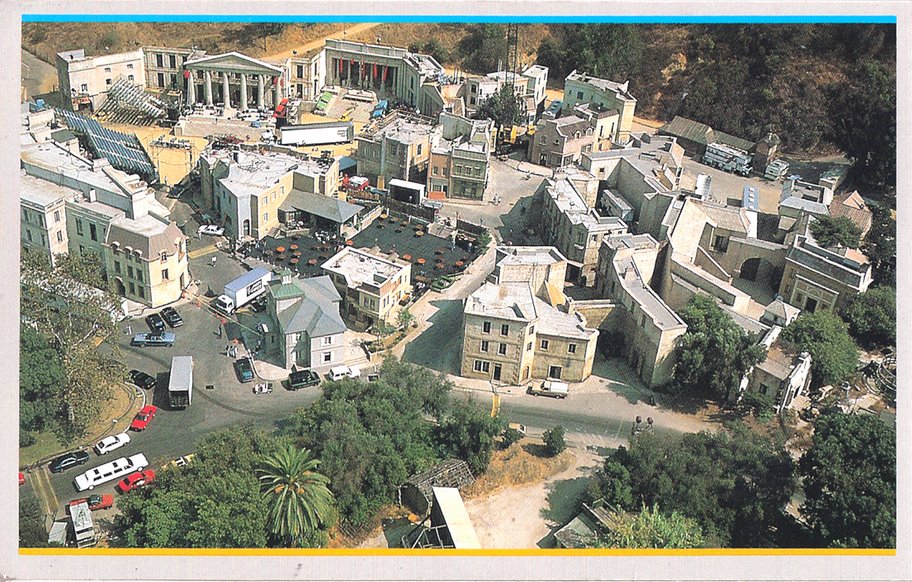
Universal Backlot


Little Europe today


Like other Universal horror films, ‘Dracula’ and ‘Frankenstein’, the ‘Invisible Man’ production was centred around the Little Europe sets. Although, there was a small fire in the Little Europe area which disrupted the production in August 1933, it was the fire in May 1967 that completely destroyed the historical set. Today, replicas of the buildings have been erected that are used both as tourist attractions and for modern film productions. Some shots of the external sets that can be seen in ‘The Invisible Man’ show stark similarities with the replicas on the Universal Backlot.
Little Europe in 'The Invisible Man':     


And Little Europe today:


 That's it from me. A special thanks for Kristen at 'Journies in Classic Film' for organising this blogathon, it was a fantastic idea and I learnt alot from researching 'The Invisible Man'.